Sunday, November 26, 2017

Shepherd, Sorting King and Holy Sheep - Matthew 25:31-46


What is a king?  What does it mean to have a king?  Who is a king?  In this land of democracy, which was built throwing off our ties to a king and breaking out on our own without the fetters of a dieing feudal system and its monarchy, what does it mean to say that Christ is king?  England still has a queen and will someday in my lifetime have a King. But the monarchy there is little more than a living parade, a living heirloom of by gone days of England’s past. But many countries still have kings in far off places of this world.
Every year at District Pastor's Retreat, a group of us go to eat at a Thai restaurant. They have three pictures of this very regal looking couple on three of the walls. One year I asked the waitress who this couple was. She told us that they were the king and queen of Thailand. From what I understand, the king and queen of Thailand are held in great affection by the Thai people. The waitress told us quite a bit about how wonderful this couple is and how much they are revered and respected by Thai people everywhere. The owners of this restaurant live here in the states, but they still honor and revere the king of their native land.
A good king is respected and honored by his people. A good king is kind and just and is loved by all those whom he rules. But a king does not have to be these things in order to be king. A king is a king by birth, by having been born in the right family at the right time, or by coo, by over throwing the current king and taking over his throne and establishing his line and his lineage as the new succession to the throne. A king is king by power of the law but ironically in many ways is above the law and not required to adhere to the very law which makes him king. A king can still be king due to this power he wields even if he is cruel and tyrannical. A king can still be king even if he squanders the people’s money and mistreats them at every turn. As long as he can hold onto his power the king. History shows us that a king can be good or bad; kind and just, or tyrannical and bent on nothing but his own gain.
So there are kings who are revered and honored, kings who deserve to be praised for their kindness, generosity and the just way they rule their people. When we look to God, we, as Christians would expect that Jesus, as king, would be the later. This passage presents to us Jesus, as a king who divides people as a shepherd separates sheep from goats. The sheep he allows into his kingdom and the goats are thrown out, not allowed to enter.
In every place I have ever heard of there being a King, the King does not get to choose who his people are. He is born to be king of a particular kingdom and all the people in the kingdom are his people. A king just accepts the people he is given. Just as he was born to be king, everyone else, who was born within the borders of his kingdom, are born to be his subjects. But Christ the king is picky. He does not simply want subjects, he wants a certain kind of subjects. He wants subjects who live and act in ways which he deems worthy, just. He only wants subjects who are righteous, for it is those whom he calls righteous he decides are the sheep and accepts, it is those who do not live in righteous ways whom he calls goats and casts out.
Jesus is not only our king but he is choosy about those who will be in his kingdom. Jesus, the Son of Man will sit on the throne of Heaven and divide up those who are in his kingdom and those who are not. On his left he puts the goats, saying to them that he was hungry, thirsty, a stranger, naked, sick and in prison and they did not feed him, give him something to drink, welcome him, cloth him, take care of him or visit him. To the right he puts the sheep and he says to them, I was hungry, thirsty, a stranger, naked, sick and in prison and when you saw me you fed me, gave me a drink, welcomed me, clothed me, took care of me, and visited me. To those on his right, he praises them and welcomes them into his eternal kingdom, to those on his left he will cast out of his kingdom where they are punished.
And all the good protestant Christians, who know that the grace of God and the gift of eternal life are freely given to those who have believed and have and know that entrance into God’s kingdom cannot be earned by merit or by good works, scratch their head and begin to wonder, “when was it that the world turned upside down and how is it that everything we believed to be true about how these things work can proved to be false?” 
What is Jesus saying?  It sounds like he is saying that in order to be accepted into Christ’s kingdom we have to do certain things. Earning our way into God’s eternal kingdom is done by giving to those who are less fortunate. That can’t be right, can it?  It goes against everything that I have ever been taught, when it comes to how the grace, and forgiveness of God works.
But that is what Jesus says there. I just read it, “Then the king will say to those at his right hand, ‘Come, you that are blessed by my Father, inherit the kingdom prepared for you from the foundation of the world; for I was hungry and you gave me food, I was thirsty and you gave me something to drink, I was a stranger and you welcomed me, I was naked and you gave me clothing, I was sick and you took care of me, I was in prison and you visited me.'. . .‘Truly I tell you, just as you did it to one of the least of these who are members of my family, you did it to me.' Then he will say to those at his left hand, ‘You that are accursed, depart from me into the eternal fire prepared for the devil and his angels; for I was hungry and you gave me no food, I was thirsty and you gave me nothing to drink, I was a stranger and you did not welcome me, naked and you did not give me clothing, sick and in prison and you did not visit me.'. . .‘Truly I tell you, just as you did not do it to one of the least of these, you did not do it to me.' And these will go away into eternal punishment, but the righteous into eternal life."
It says it right there if you give food the hungry, water to the thirsty, welcome the stranger, cloth the naked, take care of the sick and visit the imprisoned we will be called righteous and welcomed into eternal life. Jesus says it, so it must be true.
It is true, in that, those who love Christ and seek to live as Christ lived and be the people Christ calls them to do these things do these things. It is not true that these are the things that gain entrance into Jesus’ kingdom. Yet it is true, in that because faith and belief came first; faith comes before the actions. In fact faith is the reason for the actions. Those who live the love of God in their lives, those who accept the truth of the gospel of Jesus Christ and have faith in him for eternal life, will visit the sick, cloth the naked, welcome the stranger, give water to the thirsty and feed the hungry. They will do all these things because their faith compels them to, because the love they have from Jesus will not allow them to not.
Faith is a strange kind of belief. Faith is a belief that is lived, it is a belief which can only exist in action. You can believe that a force called gravity keeps us firmly stuck to the ground. You can believe that the world is made up of tiny electrically charged particles whose properties dictate how our world works but those kind of beliefs require nothing of us. We either believe that these unseen forces are at work in our world or we don’t. There is nothing that believing or not believing in electrons requires of us, but faith in Jesus Christ, requires something of us. It moves us, it changes us and spurs us into action.
Once you know the truth of the gospel, once you come to and understanding of the God of the universe and that God’s love for each and every one of us, that love, that truth changes who we are, it changes how we live. It compels us to move in our world in loving ways. The love of God is a love that requires us to then in turn love those around us. If we truly understand that God loves us and calls for us to love the world around us, we cannot see one who is hungry and desire to feed, see one who is thirty and desire to quench that thirst, we cannot see one whom God loves and cherishes in pain or in need and not desire to reach out with the love that God had given to us and share that love by soothing that pain or meeting that need.
If we truly believe that God loves us. If we truly believe that Jesus Christ showed that love in his life, teachings, death and resurrection and that love calls us into relationship with the God of the universe and then we cannot help but be filled with that love, that love fills us, lives in us and is worked out in our actions and interactions in this world. The love we have for Christ is manifested in our love for those around us.
Christ, the king of heaven, knows that if we truly love him, then that love will be lived out in how we treat those around us. When we love Jesus we will treat each and everyone we meet as if that person were Jesus. As Christians we should see Jesus in everyone we meet, in everyone with whom we interact. We should treat our boss, our siblings, our parents, the stranger we pass on the street with the love, the dignity and the respect with which we would treat them if we truly believed them to be Jesus Christ himself.
Although it might be easy to get the cart before the horse, so to speak, and think that Jesus is telling us that it is the doing of these things which gets us into Heaven. But in fact this passage is not putting forth this kind of works related righteousness. Jesus is not telling us how to earn our way to heaven, instead he is describing what a life lived in love with God, a life living out that love will look like. They are the mark of one who is sanctified. They are the outward signs of Christian perfection. This is what holy living looks like when lived out by God’s people. 
This is not a prescription of how to get to Heaven, feed three hungry people, take a cup of cold water to one who is thirsty and call me in the morning. This is a description of what a life lived completely and totally given over to God will look like; if you love Jesus. This is what a holy life looks like. When the people of God are living out God’s holiness in this world then, the hungry will be fed the thirsty will be quenched, the stranger will be welcomed, the naked will be clothed, the sick will be taken care of and the prisoner will be visited. Those who are in need around you will be provided for. You will live a life of compassion. You will love each and every person as if they themselves were God. You will speak to each person you meet as if they were Jesus Christ. Everyone you meet will be treated with the kindness, the respect, the love you would give if they were Jesus. You will honor everyone as if they were you king. When you love God, you will love your neighbor. When you love Jesus Christ you will love the outcast and the lonely. The love of God will be the hallmark of your life. When people encounter you they will encounter the love of God in you, because you are loving them as if they are God. This is what it means to be holy, to live out God’s holiness in your day to day life.
We love because God loves. We love because we believe. We love because our faith compels us to. We cannot love Jesus without loving those around us. We cannot be people of faith unless we are feeding the hungry, quenching the thirst of the thirsty, clothing the naked, welcoming the stranger, taking care of the sick and visiting those in prison, because that is what a life of faith will look like to one who is observing it from the outside. It will be a life marked by action, a life marked by love moving; a life marked by someone who cannot stand by and to allow those around them to suffer.
Our faith moves us in ways that will not allow suffering to continue to go on around us in this world. A true believer in Jesus Christ will not go unmoved when another is suffering. A true adherent to the faith cannot but help but be torn apart when someone around them is hurting. We, as follows of Christ will be forced into action by our faith and by our love for Jesus to mend the broken, and be balm to those who are hurting. The love of Christ compels us, moves us and transforms us in ways so that we are ruled by an over powering, outreaching love that will not stop until we have loved all those we touch and are moving to right the wrongs that Jesus himself came to this world to right. 


Sunday, November 12, 2017

Fish in a sea of Justice - Amos 1:1-2, 5:14-15, 21-24


The sun is shining through the artistically colored windows. The worship team is at its prime. The people are all dressed in their Sunday best, poised and ready for worship. They are standing tall, faces up lifted toward the sky as the music is about to begin. There is a quiet reverence in the sanctuary. It seems as if nobody is shuffling, nobody is restless, and everyone is focused on the song they are all about to sing. Even the dust gently drifting in the luminously colored beams of light filling the sanctuary seems Holy. The voices raise, the chorus begins, but God can not hear the words of the song because of the chaotic din. The man on the third row is wondering if he can nonchalantly slip his cell phone out of his pocket. He is positive that the service started a few minutes late, will that mean it will run a little late, will he be able to make it downtown in time if the service is 5-10 minutes over. Why did he sit on the third row? He can’t sneak out toward the end, everyone will see him. He stands looking up at the screen singing the words. His face looks focused; by all appearances he is engrossed in worship. There a woman toward the back on the right. She is smartly dressed; her hair is neatly pulled back. She is the picture of modesty and propriety, but as she sings she begins to wonder if she can get away with cutting Amelia’s pay, she just can not afford to pay that woman as much as she is getting paid. Perhaps, she can tell Amelia that the work she did this last time around was just not up to par. Sure she knows that Amelia works herself to the bone and really does a fine job, but sometimes you just have to pay someone a little bit less. She can tell Amelia that the seams were just not right that she was just not as happy and then simply give her 20% less than the agreed upon price for the garment. It will be OK, Amelia will find a way to make up for it somehow, I bet she over charges some of her customers anyway.
As the song proceeds the din grows louder and louder. God looks down on the people, hands over ears waiting, waiting for the noise to stop, waiting for the din to die down, but the service seems to go on. And on the raucous get louder and louder and finally something has to be done. It is at this point that Amos (the tree farmer and sheep herder) shakes his head once again wondering why God can’t give him something pleasant to say to these people, he steps out of his anonymous place in the pew into the aisle and raises his voice above the melodious strains of pious worship and says, “This is what the Lord God has said to me, ‘I hate, I despise. . .’”
God cannot hear the worship. The worship is pointless, the worship is useless, the worship is not worship, when over laid with the din of un-worshipful attitudes which fill the sanctuary. God wants to mourn, God wants to wail, this is an outrage this is deplorable. God will turn their empty songs in to wailing, their hollow praise into mourning. If they want the festive worship over so they can get on with business, God will put a stop to the festivities.
God is a little more than fed up with the people of Israel at this point. When it comes time for the festive observances which God had set up for them; they are not grateful for the break from the routine, they are not joyful in the celebration of how God had provided for them once again; they are not enraptured and engrossed in worship of their God who lovingly and faithful takes care of them in season and out of season. Instead they can’t wait to get back to business.
They can’t wait to get back to their shops and to their markets they cannot wait to get back to work. Not because they need the money and every moment they are spending away from their labors is resulting in not being able to earn the money they need to survive, but because they want to get back to business practices which are just a little on the “shady side” to say the least. They are selling their harvests with bushel baskets which are too small. They are doing business with falsely weighted scales which are in their favor.
Not only are they dishonest in their practices but they are cheating the poor and robbing the needy of their due. God had set up a system by which no one in Israel would go hungry and in their practices they are sweeping up every last grain so they can sell it with their dishonest weights and their small bushel baskets, but they were forbidden by God to sell the sweepings. They were not allowed to go back through the field and harvest what they missed. They were not allowed to take a broom to the threshing floor and pick up every last grain. They were to leave this to those who had fallen on hard times. They were to leave the leftovers for the poor and they needy, so they could come and pick up the scraps which were over looked. But they were not doing this; they were picking every last head of grain and picking up every last wheat berry so that they could turn the most profit, while the most vulnerable in their nation starved to death on their doorsteps, searching for the food which was rightfully theirs by law. They are not respecting each other and in doing so they are not respecting God.
In chapter two is says they are selling the righteous for silver and the needy for sandals. In the ancient near east slavery was a product of extreme economic hardships. These people are being sold in to slavery not because they cannot pay off a great amount of debt, but over small amounts, a single silver piece or the cost of half a pair of sandals, not the cost of both, but just one. They are heartless and greedy and are not doing their best to raise the status of those around them. But instead they are taking advantage of their situation and being cruel in the process. In their practices they are crushing the heads of the poor and pushing the afflicted, those whose physical ailments are lifelong hardships, the blind and the lame; they are pushing these people aside, so they can simply walk past. They have no lack of imagination when it comes to ways in which they can use the misfortunes of others to help better themselves and their situation in life.
The people are doing all the right things in the sanctuary. They are worshiping God in all the right ways, with all the right actions and all the right words, with nary a word about any of those false gods. They know better than that, they know the first commandment. They are gathering for worship, they are participating in a proper Sabbath, they are honoring all the designated festivals, attending all the allotted assemblies with just the right amount of dignity and solemnity which each occasion requires. They burn their burnt offerings, they give gracious amounts of grain offerings, they find the prettiest lambs, the strongest bulls and the goatiest goats and offer each one at the right times. But it is not what is going inside the sanctuary that God is upset about. It is precisely all the things they are doing when they are NOT in the temple that has God all riled up at this point in time.
The thing is, God does not ask for much. God simply asks for them love good and to seek it in all things and to establish justice at the gates. God wants them to love good, to seek what is good. Not just good for me but good for all, good for those around me, good for my family, good for my friend, good for my neighbor, as well as good for the stranger and even for my enemy. Seek good, do good. Seek always in all things to do what is right.
God is saying that good and right practice should be the general rule of life. The people buying and selling things should be fair in the ways in which they do so. The people giving loans should not take advantage of the needy and the poor. Those who are doing evil and unrighteousness as a part of their common business practices should cease. Evil is never best business practice. Unrighteousness is not just a by product of how things get done in the world. God's call on our lives in this passage is simple, don't do evil, instead seek to do good. Do not cheat the poor. Do not take advantage of the down trodden. Do not do further harm to those who are already struggling in their day to day lives.
The first step is to not do these things, to not participate in the evil and unrighteousness that is all around. But if you are already not actively participating in actively harming those around you, your work is not done. You are responsible for yourself and your actions. You are to love good and hate evil; to despise unrighteousness and seek good in all you do, but your responsibility does not stop there. Once you, yourself are doing and seeking good in how you act, then the next step is to open your eyes look around, and see where injustice still occurs, see where and how people are being misused and abused and work to put an end to it wherever it takes place. It is not good enough to simply behave properly ourselves, we are also expected to establish justice. To work to assure that the world in which everyone lives is defined by fair and just practices. We are to work to end the mistreatment and misuse of human beings in our society and the world. We are called to love good and hate evil, but we are also called to work to bring righteousness and goodness to all parts of our world. We are not to not simply stand by and allow the people in the world around us to be mistreated. WE are called to speak up, to work in whatever way we can with our actions and with our votes, to establish justice in all corners of our society.
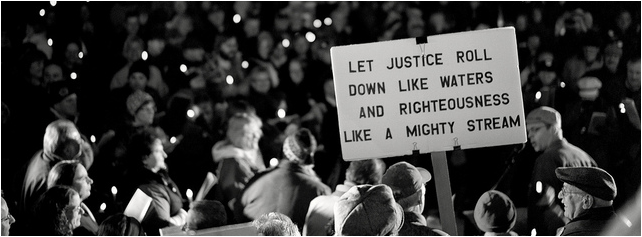
At the end of the passage God tells us that we are to, “let justice roll down like waters and righteousness like and ever-flowing stream.” I make special note of this because this is a rich and amazing metaphor. The words for water and ever-flowing stream are words that indicate water in abundance; water that is always there, always flowing, always moving.
Water was not abundant in the ancient near east. In the spring water would run in streams but for most the year the stream beds were dry. God calls for righteousness to be an ever-flowing stream; a stream that does not ever run dry. This is a picture of water that stays, that does not come and go with the seasons, but water that is always there, cool and life giving at all times.
God does not want us to seek justice that trickles through the land like a tiny water driblet, or righteousness that is like the dew fresh and clean in the morning but gone by the afternoon. God wants justice to be a lake we can swim in and righteousness to be a waterfall we can stand under. There is enough for all, more than enough for all. It is flowing down and over flowing the river beds and flooding the lives of everyone around. This is extravagant justice, exorbitant righteousness. It is enough for everyone to drink and be filled. Enough for us all to jump in and swim around, so much justice that is it unseemly, so much righteousness that it quite frankly wasteful.
The world as God wish it is an luxuriously apportioned mansion of the insanely rich. If justice were gold, the whole thing would be guilt. If righteousness were marble, not only would all the floors be made of it but the walls and the ceilings as well. Some might say that is too much or too far, but God says when it comes to righteousness and justice there is never too much, there is no such thing as going over board.
It is easy to think that the second of these two things God is calling for is the lesser of the two. Surely being responsible for my own actions and my own deeds is the primary call in this passage. Although we begin with ourselves, our actions, our attitudes, the ways in which we act and interact on a daily basis; although it begins with loving and seeking good in all we do, and in every part of our own lives, it does not end there. The second part is just as important if not more so than the first. Not only are we to assure our own actions are good and righteous, that we ourselves are not taking advantage of others, but we are to make sure that we do not allow, or stand by while others in the world around us are continually mistreated by others, by the systems, by the common practices that are just apart of “how our world works.” We are to work to stop that being the way things work, to end the injustices in our society and our world. To break down those systems and repair the broken parts of our society. We are to break down the damns that hold it back and let it flow, let justice go rushing into the the lives of everyone in our society. And let us be the ones who work every day of our lives to break that damn and to allow it to flood our world, so that it is literally the water in which we live. Let us all be fish swimming in a sea of justice and righteousness. Let it be the waters in which we live and the very air which we ALL breath and let us not stop, let us not rest until it is so.


Saturday, November 4, 2017

God of the Silence - 1 Kings 19:1-16

Things never went very well for Elijah. It seemed the people never listened to God. When they did not, Elijah was always asked, by God, to go back to them, and give them the opportunity to change and turn back to God, or suffer the consequences of their unfaithfulness. The pesky thing about always being right is, no one ever listens. Time and time again the people chose to do their own thing and not heed the warning from God, Elijah brought to them. Then, when God's protective hand was removed from them, and terrible things happened, it was always Elijah's fault. God said, “Repent, change your ways,” the people refused and there was a famine and a drought for three years. It was Elijah's fault, so he was forced to hide in the wilderness being taken care of by birds.
Even when it seemed he had won, he lost. One of the huge problems at this time in Israel's history was that the King had married a woman who worshiped Ba'al. She had imported idols and priests and prophets of Ba'al from her homeland. Because of her influence many people had turned away from God to worship Ba'al. Others, in an attempt to keep all parties happy, were worshiping both, which was not at all better in God's eyes. (See the first commandment)
All the prophets of Ba'al had set up a giant reality contest, “Whose God is real, anyway?”  They would get as many people as possible to come to this grand event.  The premise was: all the prophets of Ba'al (450 of them) would build an alter to Ba'al, on one side, and Elijah would build and alter to the Lord God, on the other. They would each place an offering on their alter. Then right there in front of everyone, they would each call out to their god to reign down fire. The god who managed to set the offering upon their alter on fire, was the one true god.
The prophets of Ba'al made a royal ruckus, singing and yellin' and prayin' at their top of their lungs to make sure Ba'al hear them. Nothing. Maybe he was asleep and they needed to make some noise to wake him. When that did not work they began jumpin' and dancin' all around the alter to get Ba'al's attention. Nada. Perhaps, he was binge watching Netflix and was too distracted to notice them.
Finally they started cutting themselves and bleeding all over the place. Perhaps Ba'al was 1/10 shark and would smell the blood in the air and come running with great bombs of fire. Nope, nothing. Ba'al was in the shower, singing, “rubber ducky you’re the one” at the top of his lungs and could not, hear, notice or smell anything that was going on down on that mountain that day.
At this point Elijah, being a good sport about things, started taunting them mercilessly. “Nanni-nanni-boo-boo my God's gonna do what yours can't do.”
Then to show what a really a good guy he was about this whole affair, he dug a three foot wide trench all around his alter. Then he had jug, after jug, after jug of water poured all over his alter. So much water that it poured down over the offering, over the wood for the offering, over the sides of the alter, filling the entire trench that surrounded it. And then Elijah began to pray, and immediately fire came down from the heavens. Fire came licking down over the alter, consuming the offering, the wood, and all of the water, nothing was left, not even one drop of water.
Elijah had won; God is the one true God of the universe. God one, Ba'al ZERO. And the crowd goes wild. Elijah is hero of the day. God is God and Ba'al is not. But like I said, even when Elijah wins, he loses, because this whole thing angers Jezebel, the queen, something fierce and she put a hit out on Elijah. Before Elijah can really revel in his moment of victory, he is running for his life from a band of royally sanctioned hit-men. He leaves his servant in a safe place, because he does not want his servant to die too if they are found together. Out into the wilderness he goes, again. He knows that Jezebel's hired guns are too chicken to follow him, or too dumb to find there.
So here Elijah is, out in the wilderness, the henchmen of Jezebel after him.  He is on the run, but even a man on the run gets hot and tired. So he finds a solitary broom tree way out in the middle of nowhere, a day’s walk everywhere. He looks to his right there is no one, he looks to his left, no one. He is safe, there is no one can be seen in any direction. He sits down there in the shade of the tree and he feels absolutely, completely and utterly ALL ALONE.
When evening comes, he lies down and stares up at the sky; it is mostly void, and partly starry. He stares up into the nothingness and asks God if he might die. He thinks about his life and the lives of all the prophets who have come before him. Where are they now? They are nothing but dust and bones and he says to God, “Enough is enough; I am ready die, for I am no better than my ancestors.” And then he lay down and fell asleep, hoping God would grant his request.
He must have been pretty disappointed when God woke him and told him to eat and drink. So he ate and drank, but miraculous food and drink was not enough to impress him. After eating and drinking food that appeared out of nowhere, he laid down once again hoping to die. But again, God disappoints him, and wakes him up again, telling him to eat and drink and so he does.
This time, God does not allow him to go back to sleep but instead encourages him to keep moving. He travels all the way to mount Horeb, which is also known as Sinai, the very mountain on which Moses met God all those years ago. He climbs the mountain and finds a cave and settles down in the cave.
And God says, “What are you doing here, Elijah?”
And Elijah says, “God I am always doing what you tell me to do. I am a good prophet. I tell the people what you tell me to tell them, I do what you tell me do, and nobody ever listens. Nothing I do ever makes a difference. Every time I do the right thing, it comes crashing back down at me. It like a reverse Midas touch, instead of it all turning to gold, everything I touch turns to ash. It is all ruined. I am all alone, and everyone wants to kill me, and I kind wish they would.”
How many of us have felt like this? Nothing we do seems to go right. Everything seems to be torn to pieces the moment we touch it. The world around us has crashed and burned and there are no pieces to pick up. We are going through a rough time. Our heart aches, within us. Our body is one giant nerve in pain. And we look around and there is no one. We are all alone. Nobody could possibly understand how we feel. Nobody is really there for us. Everyone we love is dead. Everyone who could help us, is gone, or nowhere to be seen. We look to the left, we look to the right and there is no one there. On one hand we are relieved. Sometimes it feels good to be alone in our pain, in our grief, in our sorrow, in our hurt. But then again we are all alone, absolutely, positively alone. There is no one here with us in our hurt, in our grief in our pain. And perhaps, on one of our really bad days (or on two or three) we have thought, death would be easier than continuing to deal with than this. That is exactly how Elijah felt that day.
And so God told him to hang out there on the mountain for a little while and left him alone. As he stood there, completely and absolutely abandoned, the wind picked up. It howled in the trees and made a hollow moaning sound in the mouth of the cave. It whipped up over the rock face and whistle against the stone. It was blowing so hard, Elijah had to cling to the rock to not be carried away by it. But even in all its grandeur and force, Elijah knew that God was not in the wind.
As soon as the wind died down, the earth began to quake, it became as mobile as the sea. The mountain, on which he stood, bobbed up and down like a toy boat in a child's bath. The rocks rolled like waves. But even with all its power, Elijah knew God was not in the quake.
As soon as the ground became sturdy again, fire rolled across the mountain. It blazed with a fierceness and with a fury the likes of which Elijah had never seen, but just as with the wind and the quake, even with all its glory, Elijah knew God was not in the fire.
When the blaze died down, Elijah looked across the mountain, across the valley, across all the world that could be seen from his vantage point. He looked around and saw in the barren world around him a stillness that could not be explained. And he heard nothing, absolutely nothing. The world was filled with the sound of sheer silence and in that stillness, in that silence Elijah knew, just as he knew he had ten fingers and ten toes, two eyes and one nose, God was there in the silence, closer than God had ever been before.
When we are struggling, when we are hurting, when life seems too much to handle, we want God to come to us in a thunder cloud, like a bolt of lightning. We want God to be all smoke and lights, to “razzle dazzle” us. We want the God with the booming voice. But when we are hurting the world is muffled. It is almost as if volume of everything around us is turned down. It is as if we are trapped in a jar, able to watch the world go by unable to sense it, to feel it, to hear it. Or perhaps the volume is turned way too high, we feel everything to eleven, feathers are sharp razors and even the dim glow of a firefly on a summer night is too bright. Either way, in these times, we could look in the wind, in the fire, or in the shaking of the earth but we will not find God there. It is not that God cannot be in the cloud, in the smoke or in the fire, in the thunder or in the rain. God has proved at other times that sometimes God can be found in those places. But, when we are hurting, that is not the time for loud booming voices, for burning bushes or pillars of fire, it is not the time to fill everything with smoke or to shake our world to get our attention. When we are soft and vulnerable, when we are hurting and raw, God comes to us in the silence that we feel all around us.
When we are hurting, when the world is all razor blades and blinding lights, or when we are so deep in our sorrow that the world is wrapped in a deep blanket of wool, so far away that it cannot be felt or heard, we know the silence that surrounds us. It is a thing we can touch, it can be felt, it is as sharp as any knife and as soft as a kitten. It is a thick blanket of snow on a frosty winter morn. It is a thing that is there. It is a thing that is known. This silence in which we live, it keeps us company. In these times when the silence around us becomes a living breathing thing which surrounds us, we find that it is God that is there in that ever deafening silence; surrounding us, filling our lives with the very presence of God. The presence of God, encasing us, so that nothing but God can be felt there; can be heard there. When we feel nothing, when we see nothing, when we hear nothing, God is there in the silence, embracing us, holding us. Even when we are hurting too much to feel God; even when we are blinded so badly by the circumstance that surround us that we cannot see God; even when we are sobbing too loudly to hear God, God is there in the silence, in the pain. Even when we wish we are dead, God comes to us and fills our lives so that we can see nothing else, feel nothing else, hear nothing else but the silence that is God in our lives in our hurt and our pain.
And then God picks us up and reminds us that we are not alone, God is there with us. And even when we think that there is no one left for us, God takes us to people. God reminds us that we do not live for ourselves we live for those who come after us.
Elijah declared to God that he was no better than his ancestors. He was no better than the prophets who had gone before him. And he was right; God showed him that he was right. His ancestors, Abraham, Isaac, Jacob, and David had all struggled in their lifetimes, with hurt, with disappointment in God. The prophets who had gone before him Moses, Eli, and Samuel, he was also no better than they. They had done what God had called for them to do, and things did not always go well for them.  All of them struggled with how they felt God had left them, abandoned them, and also with their own failings but through it all they had sought God, even in when they failed they called out to God and found God was there. They hurt and struggled, just as Elijah is doing. And their lives are a testament to the ever present nature of God.
Elijah was no better or worse than his ancestors, not in the way he thought, being nothing but dust and bones, but in that they had lived and struggled and found God to be faithful. And God, like God had done with all those before him, assured him that that God was faithful in his life as well. And then encouraged him to be like his ancestors and move forward in such a way that would assure that he like his ancestors before him would live his life in such a way that there would be others who would follow after him. Elijah went and found Elisha and spent the rest of his life assuring that there would be a faithful prophet to come after him so that he could follow in the path of his ancestors, making sure that others would forever come after.
When we are hurting it is good to look back through history and know that others have hurt like we have hurt. It is assuring to see that others have struggled as we have struggled; that others have found God to be faithful and know that we too can find that God is faithful. There is peace and comfort we get from the long line of ancestors we can find along the path behind us. If we look we can always find someone who is “just like” us who struggled in similar ways we do, who hurt in similar ways that we do. We can find God faithful just as they did. But we can also see in them who we want to be, who we aspire to be, people who lead others in the path as well. God does not ask for us to go find whole boat loads of people. God just asks for us to go find one. God sent Elijah to find Elisha. Go find the one Elisha, the one who will carry on the legacy of faith that was begun through all those who came before us. The way we assure that there is a legacy of faith that comes after us, is if we continually have just one person we are working with, loving into the kingdom, training in the faith, living as an example before. Just one. You are Elijah, who is your Elisha?

Sunday, October 29, 2017

The Presence of God - 1 Kings 8:1-13


So after Samuel anointed him king, the boy David grew up, as boys are want to do. And after some things happened and then some more violent things, he did indeed eventually become king. He had some wives, and one who was someone else's, and some children. He fought in many wars, and through those wars. And some small amount of diplomacy established Israel as a nation among her neighbors.
When his wars had settled down and he began the work of setting up Jerusalem as the seat of his government. He built a palace there and wanted to build a house for God there as well. But God told him that this task was not for him. David was just a little bit disappointed, but he was wise enough to not attempt to build something God specifically told him not to and that was the end of that.
So after some time, David died, as boys are want to do, when they are old men. His son Solomon became king after him, after a few not so minor disputes, involving swords, and a small amount of bloodshed. Something that is want to happen, when a country has not yet established a clear process concerning the passing of power from person to another. After this many more things happened, many of them deemed to be very wise, because Solomon was known for his wisdom. Some of them were not so wise, but of even the wisest among us do some very unwise things. Anyway, Solomon decides it is time to do the one thing his father had wanted to do, but was forbidden to do, build the temple. God had always said that God did not need a dwelling place made of wood and stone, but since it was something that seemed to be important to David and to Solomon, God would choose to abide in a temple if he were to build one. So after seven years and no small amount of forced labor (again sometimes wise men do some very unwise things), the temple is finished. And it has come time to dedicate it.
On that day, they brought everything up out of the tabernacle. That is the mobile tent, in which they had worshiped since their long journey through the wilderness, when God brought them up out of slavery in Egypt into the land in which they now resided. After they had brought up all the implements of worship, they brought up the Ark of the Covenant, which was basically a very elaborate box, on which sat two carved cherubim. Inside are two tablets onto which were written the covenant God had made with the people and the people with God. It was often the preferred meeting place for God and Moses throughout the wilderness wanderings. The bringing up of the Ark, symbolized God coming into the temple. From now on God would meet the people here in the temple Solomon had built.
The Ark is taken into the temple and put in the inner most room, the most holy room, the room set aside for God. It was placed there, set between two great cherubim, underneath their outstretched wings. It was there in that space, above the cherubim atop the Ark and underneath the wings of those that towered above, in that dark, innermost, windowless room, God would “reside.” Once they had it all set up, it was perfect. The room neatly contained the Ark and even the long poles which had been used to carry it all those years. It all fit beautifully in the room. You could just see the poles, but all that was considered most holy was contained in that one little room.
During the days of their travels, God had led them with a pillar of cloud. It was said that the very presence of God was in the cloud, that it was the physical manifestation of God, leading them, guiding them to the land God was giving to them. That cloud of the presence of God had always been with them, until they had settled and taken up residence in the land which God had promised to them and to their ancestors.
When the priests had finished putting everything in its place and the priests had just come out of the room. Then with all the priests and the elders gathered there something happened, something unexpected, something, just a bit frightening. The presence of God filled that place. Here, on the day of the dedication of the temple, as soon as they had finished putting the Ark of the Covenant, the meeting place of God, into the inner most, holiest part of the temple, that same cloud filled the temple. God filled the temple. And everyone left. The scripture says, “a cloud filled the house of the Lord, so that the priests could not stand to minister because of the cloud.”
God came into the temple. God had come into that most holy of places, just as they had desired. But God did not stay there. They had built the room perfectly, it was just big enough to hold the cherubim and the ark and even the poles of the ark, but the room was simply not big enough to hold God. God came into that room and came pouring out filling the entire place. They had built a room to contain God but it was just not big enough.
They had wanted God to come. They had invited God to come. I mean they had built the whole place for God, but they are surprised, frightened even, when God actually shows up. And they are surprised when God does not stay where they put God. They are surprised when God does not fit in the room they had provided. They are frightened when God is bigger than they expected. They are frightened when they realized that God cannot be contained by anything which they have built.
They wanted God to show up but are chased out of the temple when the presence of God actually arrives. I want you to hear me, Church. God is bigger than anything we build. God is bigger than our sanctuaries. God is bigger than our buildings. God is bigger than anything we can imagine. Our God is bigger. Whatever it is, God is bigger.
We are probably not surprised that the God of the universe; the God who hovered over the deep, at pre-creation; the God who spoke the world into existence, who created light itself and the dark as well; who flung the stars into the sky and who reached into the dust of creation and formed humanity, breathing into us, giving us life; that God cannot be contained by anything we have built. No tent, no house, no temple ever devised by the human brain and then built with human hands could ever hold God. I can think of little else that makes as much sense as that.
The largest failing of religion, is that through religion we attempt to understand God. We think that by building walls of theology, doors of dogma, rooms out of articles of faith, roofs with manuals. We think that if we search enough, discuss enough, explain enough, think hard enough, we can place God right where God belongs in our holy of holies; that we, by understanding God, that God can be contained in our understanding. We think that God can be seen and held, that by wrapping God up with thoughts, ideas and words, with theses, and creeds and articulations of our faith, that we can build a place where God can safely reside. But God cannot. One of these days we, as the people of God will see, that all these doctrines, creeds, and articles are good pursuits, but that expecting God to reside within the walls of our understanding is a vain pursuit. As soon as we set up the walls, the perimeters, no matter how holy our pursuit, when God comes in, God is bigger, so much bigger.
The temple was a great idea, setting up a place most holy was a great idea, it is a fair and honest endeavor to provide a place where the people of God can come to meet God, to give the people a place where they can come to seek to understand God. But we should never be surprised when God is bigger than that. At some point in our seeking, in our understanding, we must realize that we can never wholly understand God. We although seeking God is a holy and blessed endeavor, God cannot be found, in any hiding place. We can never call out, “Olly, Olly, ox and free” and expect God to come out in all God's glory so that we can see God in God's entirely and know God completely. Our God can be sought, but can never truly be found.
We seek God so that we might know God, so that we might catch a glimpse of this one who we worship; this great and mighty God of the universe, who chooses to draw near to us, who chooses in some small, yet great way to reside among us. We hope to know so that we might understand the one who desires to be in relationship with us. But in knowing we must come to see that in seeking we do not find, in knowing we never truly understand. But yet the endeavor is never worthless, it might be our complete undoing, but what an undoing! To be undone by the one and only most holy God of the universe. The God is bigger than us, bigger than anything we can build or imagine. The God who is simply bigger.
I want to be clear, neither the priests, nor the elders, not even Solomon called God to come, and then God came. I say this because my language and even the language of the text might lead us to believe this. Language is a funny thing; it is imprecise and often lacking. It does not often convey the very things we are attempting to convey, even when we speak of mundane, common things. But when we come to understand that God is bigger than anything we can create this also includes language. When we speak of these things our words are a small and confining as that room in which they attempted to house God. When we speak the things of God, the presence of God comes pouring out of the small words, and statements we use, breaking their meaning and confusing their meaning, leaving them but poor broken vessels unable to contain that which we are attempting to relay. Solomon did not build a house for God temple in which God could reside and then invite God to come. The elders did not bring God into the temple when they brought all the holy things up out the tabernacle. The priests did not bring God with them when they carried the ark into the holy place. God did not come trailing after them like an obedient child moving house because his parents have relocated. God did not go because God was instructed to go. God did not come because God was invited.
Every Sunday we gather every Sunday, here in this sanctuary, this place which has been built for us to come and see God; to stand, if but for a moment in the presence of God. At the beginning of the service I speak an invocation, a call to worship. But I am always very careful in my language, lest any of us think that God is summoned to be among us. I am very careful to not presume that it is I, or you, or us together who invites God in to this Sanctuary. No matter how our language through liturgy or through song might lead us to believe. It is not wrong to speak thusly, but we must speak or sing realizing that at some moments our language because it cannot contain God, fails to correctly convey the mysteries of God.
We ultimately believe that this is God’s sanctuary, God’s house. It is not God who meets us here; it is us who meet God here. We do not invoke God to join us; we do not call out to God and beg God to join us. We come, we gather, we worship, we pray, we praise, because God has invited US, God has gathered us, God has called us. We are the Church because God has made us the Church. We come, we go, we gather, we scattered because that is how God the Church to move. We come into the presence of God because God calls, and have heard that call today. God does not come because we have called; we come because God has called. God is not here because we have gathered, we have gathered because God has called.  
When God came to the temple God not only filled the temple to over flowing but the presence of God forced the priests and the elders outside into the streets where the people were. There is no indication that they were able to go back in so Solomon’s prayer which follows, the service of dedication, the worship that occurs throughout the rest of this chapter, happens out there on the streets among the people.
God’s presence forces them outside the walls of the temple. God’s presence forces them out into the streets. They could not minister there in the temple and were instead forced by the very presence of God to minister outside, in the streets among the people.
I want you to walk with me for a minute here this morning. Today is reformation Sunday. And although I am hesitant to celebrate the church divided, even if it is a side effect of much needed reform, I am going to mention it this morning, because one of the things Luther heralded in his 95 theses is the priesthood of all believers. The priesthood of all believers says that all the church, every one of us who claims Christ as Lord, can stand before God as priest. That means that because of Christ the division between God and God’s people has been broken down. Each of us can stand before God ourselves. We do not need anyone to stand for us. We can pray, we can worship, we can be in the presence of God in the ways that only priests of the Old Testament could before God.
You might notice in this passage that although all the people are gathered, that only the elders can take anything into the temple, and only the priest are allowed to carry the Ark in to the holy place and it is only the priest who had remained to be chased out. The priests stood between God and the people. The people are unable to stand in the presence of God. But in Christ we do not need anyone to stand between us and God. The presence of God resides with all God’s people, because we are called to be the Church and the Church is called to be a holy priesthood taking God to all the peoples of the earth. We are all priests, in that we can all stand in the presence of God. When we come into the sanctuary of God, when we gather to pray, to worship and minister, each of us are doing so, in the same way the priest of old did. We can stand here this morning because in Christ all of us, each of us, are priests of God, gathering, worshiping and praying together in the very presence of God. This is one truth that was made clear in through Luther in the reformation, and for that we are thankful.
As God’s priests we are called us to gather, we come into God’s presence to worship God, to come to understand God, to be the people God is calling us to be, to minister, but ultimately no matter how many times we are called in, no matter how often God gathers us, the presence of God sends us out once again, into the streets, among the people to minister. We are called to be a holy priesthood to the nations, to all the people of the earth bringing God to them. Carrying the symbols, the signs, the words (no matter how faltering) that will share the presence of God with them. But we cannot do so here, with in these four walls. Inside these walls we are contained, we are hidden, like the ark with its poles, within the holy place. We cannot stay here. We may come because we have been called, we may gather because God has gathered us in, but in coming we encounter, the great, the mighty, the frightening presence of God and it is the very presence who calls, who gather, who sends us out, who scatters us  in among the people of the world to minister. To BE priest, to show them the one whom we have encountered, to carry the invitation, God’s invitation to them, so that they might hear the call, so that they might know that they too may come. So that when we gather they too may come with us. The presence of God gathers, but it is also that same presence that scatters, it is God who calls us, but it is also God who sends.  

We do not come here each week simply for the purpose of coming. We are not called here simply to worship and pray. We are not gathered so that we can study and come to understand God. The Church is not created for itself. We are not here merely for our own edification. We are plants, God nurtures us, gives us all that we need, food, water, sunlight, so that we might grow. But we are not here simply that we might grow, we do not grow so that we might merely be bigger, taller, greater. We grow that we might mature, that we might produce fruit that others might also grow. That God’s Church might multiply and grow. Come here in the presence of God so that God’s presence might drive us out into the world into our common everyday task, into our jobs, into our schools, into our neighborhoods so that there we might minister among the people that next time we come we might bring one with us, that she too might come to know the God we know, that he too might become a priest alongside of us, that they might come to know the God we know, love the Christ we love. The presence of God came into the temple that day and the priests were driven out in to the streets by God’s presence to minister there. We have come here today, and encountered this God who is bigger than we, we have encountered this God who is greater than our imaginings and let us like the priests who have come before us also be driven out into our world to minister in God’s name! 

Sunday, October 22, 2017

Called - 1 Samuel 16:1-13


Our story begins this morning, with a stranger coming to town; after all, as Mark Twain tells us, there are only two stories: a man goes on a journey and a stranger comes to town.  This story begins with a disheveled old man walking up a dusty road toward a town.  There is a man in his field on the outskirts of town; he can see the dust rising before the stranger comes up over the rise.  He stops leans on his plow, and watches for a minute to see who it is.  He strains his eyes, and as the man makes his way up the road, he comes into view piece by piece.  It takes a second for him to recognize the stranger, the realization shows on his face.  He calls one of his boys over to him. You can see him say something to the lad and the young man takes off up the road.  Before the stranger can reach the man and his field, a group of men have gathered, they are conferring.  You can hear them identify this stranger as “the prophet,” “the judge.”  There is a mumble about how his sons are no good, but he is God’s man, but what is he doing here?  The king has fallen out of favor with him.  He is displeased, says God is displeased. He hasn’t spoken to the king in quite a long time.  What is he doing here?  What does Samuel have to do with us? They talk and come to a decision.  As Samuel approaches them one of them calls out, “Do you come in peace?”   Seriously a screen play writer could not have written this better.  “Yes I come in peace, I have come to make sacrifices to God, sanctify yourselves and come with me.” And as things progress you see him making a point to assure that all the boys from one particular family are sanctified.
After the sacrificing is done, he calls Jesse, the father of this family, over and one by one inspects his boys.  The eldest one is tall and strong and handsome, an obvious leader surely. Samuel examines him closely, looks up into the man’s strong face. The voice of God speaks quietly to Samuel telling him to not look at outward appearance because God looks at the heart. Samuel looks away from the man disappointed, shaking his head, “no, no he is not the one.”  He looks at the next son, shakes his head again, “no, not the one.”  He goes through the next, and the next, and the next, until seven of Jesse’s sons have passed before Samuel, each one is not the one.  None of these are the one, do you have any other sons, (are you holding out on me?).  Jesse is slightly taken aback and a little shame faced. Yeah, he has another son, the youngest, “he is out tending the sheep and playing his harp. He really is of no account, but if you want me to call him in from the fields I can.”  He sends one of the others and shortly our hero, a handsome young man, with a beautiful smile and captivating eyes comes up over the hill running, wondering what his father wants with him.  The boy is still out of breath as Samuel looks him up and down,  looks him in the eye and says, “You, you are the one.”  Samuel anoints this one to be king.
We all remember grade school gym class, I know I do, I remember when the teams were being chosen, whether it be kickball, dodge ball, or esp. basketball, as you can imagine, I was not the first to be chosen, or the second one. I was almost always the next to last, you know right before the girl who broke her foot last week.  This is what is going on here except all the kids who are used to being to being picked first, aren’t being picked at all, and you can’t help but wonder why.  What’s wrong with them?  Are they, like Saul, out of favor with God?  What hidden flaw do they have?  What malady of the Spirit does God see that Samuel and the onlookers are missing?
It is easy to get caught up on why God does not choose Jesse’s other seven sons, and why God chooses David instead.  Since God looks at the heart and not outward appearance, the assumption is that there must be something defective with these young men that only God can see. And David must have some phenomenal inner trait that only God can see.  But the text does not say that.  Nothing bad is said about any of these young men, just that they are not chosen.  David is said to be handsome and have beautiful eyes, we do not know what God sees when God sees into David’s heart, but God chooses David, and the story of that David’s slow progression toward Kinghood begins.
And Jesse’s other sons are left standing in the field un-chosen and not good enough, or at least from this point on we forget about them.  But it is not so much that they were unchosen, just that they were not chosen to be king.  I am sure if they followed God and were faithful to God they were chosen for something else in their lifetimes, to live quiet lives as strong men of God, leaders in their town, in their clan, in their tribe, to be good farmers or shepherds, husbands, fathers.  They have stories, they have callings, they were chosen but not chosen to be king.
That is the thing to remember when we look at this anointing story, this story of the choosing of David.  David was not simply chosen, as if being chosen is an end in itself. No one is ever chosen just to be chosen. David is chosen to be king. 
David is chosen to be king, because somewhere in that harp playing sheep tending heart God sees that this one, this one can make a good king.  David is not simply chosen he is chosen to do something specific.  You can imagine as David kneels before Samuel, out of breath from running in from the field, the scent of sheep still on him, and the notes from the last song he was playing on his harp still in his mind, that he is thinking to himself, ”is this guy for real?  God has chosen me?  To be king?” 
It is not so much that when God looks into David’s heart, God sees a phenomenally spiritual man who is so amazing that God just has to choose this one to be king, but more along the lines that when God looks into this young man’s heart, God see in him the potential to be a great man of God, an excellent leader, the king of God’s people.  David is not chosen to be king because he is already amazing, but because God knows that this harp playing shepherd has the potential, if he trusts and relies on God he can be the king these people actually need. 
When God looked into the hearts of his brothers, God saw something else for them, something else a little less flashy, a little less remembered for all time, but important, pertinent and valuable each in their own way, just not chosen to be king.
The fact of the matter is not everyone is chosen to be king.  There is only one king, that is one of the things about being king, when all are going well, there can be only one. When there is more than one there is a problem and things don’t go down so peaceably.  God chose David to be king. But God also choose Jesse to be the father of a king and God choose David’s brothers to do other vital things in their community and in the lives of their loved ones.
God chooses and God chooses based on criteria we may never understand.  We may not understand why God choose those around us to do the things that God is choosing for them to do.   I may never really know why God choose an ultimately, shy, awkward, who had few friends, to be a pastor, but God saw something at 13 that those around me did not yet see and something that I most definitely did not see in myself.  But God chose me, not simply for the sake of choosing, God chose me to do that which God enabled me to do.  Not that which I could do on my own, not that any of this was within my own power to accomplish, but God called me to do that which could only be accomplished if I walked with God and trusted God.

God calls us all.  This is not like gym classes where some of us are standing last in line but God chooses us all first to do what it is that God calls us to do.  When God comes before us God does not pass us by, but chooses us to do that which God knows, once enabled and empowered by God, we can accomplish and will accomplish.  It is an old worn out saying but it is true.  God does not call the enabled, God enables the called.  But God does call.  God calls us all.  In Ephesians Paul says some are called to be teachers, and some to be evangelists and some to be preachers.  The fact of the matter is that we are all called by Go to do something, we are all empowered by God to do something.  We are all chosen, but we are not simply chosen to be chosen, to be special, we are all chosen; chosen because God knows our hearts; chosen to do that which God will enable us to do; chosen to do the work and the will of God in this world, to glorify God and to further God’s kingdom.  But we are all chosen we just need to trust and rely on God in all things to enable us to be the person and do the things God has chosen for us to do.  

Sunday, October 15, 2017

Two Men of God; Old and Young: 1 Samuel 3:1-21


So the people of Israel traveled across the desert and eventually, after many years and many things occurred, they finally found their way into the land to which God had promised to Abraham all those years before. They settle in that land and it became their home.
And in that land was a woman named Hannah, a second wife, who was cherished by her husband even though she continued to bare no children. Although her husband did not hold her barrenness against her, but instead showed her favor in all things, this greatly distressed her. So she went to the temple and prayed for a child. In fact she prayed for so long and so fervently that the priest thought she was drunk and tried to oust her from the temple until she explained her situation to him. So, instead of tossing her out for being drunk, he blessed her for her faithfulness and her zeal for the Lord and sent her on her way. And in due time (that's how the scriptures say it, “In due time.”), she bore a son and named him Samuel and when he was old enough she took Samuel to the temple and gave him over to the Lord to serve God for the entirety of his life. So from the time he was a young boy, Samuel lived in the temple and served the Lord there under the priest Eli.
As Eli is left to raise Hannah's son, Samuel, as a servant of the Lord in the temple, he has his own troubles at home. He has two sons, who are grown. And, although he raised them to follow in the family “business” they were not cut out to be priests. They cheated the people out of their portions of the meat they brought to offer, not only did they take from the portions that were reserved for the people,  that they would take from the ones that were supposed to be given completely over to God and be consumed by fire. And as if that was not enough they were took advantage of the women who came to the temple, in ways that were not appropriate to go into due to the PG rating of this of this worship service. I am sure, it would not surprise you, to hear, God was not at all please these sons of Eli and declared, if they continue in their perverse ways, they were not long for the priesthood, or this world. And that pretty much brings up to date to where were in this passage.
Samuel is a bit older now, but still quite young. He is serving Eli and serving the Lord in the temple, but he “does not yet know the Lord.” Which is not to say that Eli has completely failed in raising Samuel in the ways of God, but is a way for the scripture to let us, the readers, who perhaps have heard of this prophet named Samuel and the things he did later on in his life; letting us know that this was before Samuel was Samuel, this is the very beginning. This is where it all started, before he the mighty prophet to the people, before he was a king maker or a king breaker. He was just a boy, who did not yet know the Lord, in the manner in which we are accustomed to. This was before all that, when he did not yet have a reputation, when he did not yet recognize the voice of the Lord, when it called his name.
And that is exactly what happened on this night, when Samuel was young and still slept in anonymity. In a time when the word of the Lord was rare and visions were scarce, in the middle of night, the word of the Lord came to a child. He did not recognize the voice of the Lord at first, but with some help from Eli who realized what was going on, was able, after hearing God call several times, to understand that it was the Lord who was speaking to him and respond accordingly.
God's call to Samuel and the message God gives to him is not a great one. God explains that Eli's sons are not long for the priesthood or this world. Being a priest and a prophet in Israel is not a “family” business, especially when the ones coming up in the family a disgrace to the temple, are disgracing God and generally making a nuance of themselves. God will not allow the sons of Eli to continue to be priests after Eli. Implied is that Samuel will serve as priest and prophet for God in their stead.
No matter how much Eli might have wished for his sons to be the men of God, we can only assume, he raised them to be, they were not. Being the child of a person of faith does not make you a person of faith. In fact being trained or raised by a person of faith does not make you a person of faith. Dare I go so far to say that being trained to be a pastor does not make you a person of faith? Being a person of faith makes you a person of faith.
Here we have examples three people who are raised and trained by a wonderful man of God. But only one of them actually is willing to hear and listen to the word of God. We do not know what the faith experience of Eli’s two sons was, but we can be pretty safe in saying they did not actually possess Eli’s faith in God. They knew how to be priests. They knew how to offer sacrifices, they knew how to guide and direct others in how to worship the Lord. But there is little indication that they actually lived out what it meant to be people who loved and worshiped God.
None of us can assume that we are Christians because we have been raised in the faith. The faith of our parents is not passed on to us like a hooked nose or a crooked smile. Although it is always important to guide and direct the children in our congregation in the ways of the Lord, I am pretty sure we all know that they will not believe simply because we bring them to Church each week and work to raise them in the faith. It is the same with our own faith. We cannot rely on the faith of anyone else to carry our own. We cannot assume that just because our mother or father had deep faith that simply because we come to church and were raised by them that we too will be people of God. Nor can we rely on the faith of our teachers and our pastors. Just because we have been trained in the ways of the Lord, does not make us people of God.
Our live and our actions will bear out the truth of our faith. We may have be led by amazing people of God, like Eli, but being led and taught by an amazing person of God will not necessarily make us the people of God we should be. We can learn and grow by being taught and guided by other great Christians, but unless we seek to be the people of God they are teaching us to be. Unless we study scripture, and seek to be the people God is calling us to be, in the end the actions of our lives will reflect something other than the character of God.
On one hand we have the sons of Eli, they tricked and cheated people, and they were dishonest and took advantage of their position. They were in short, men of very little if any faith. Their lives reflected the truth that the faith in which they were raised had very little bearing on the way they were actually living their lives. Then we have Samuel, who has received the same training they have, who has been raised by the same person who raised them. What we see in his life is a person who in all things desires to be a person whose life reflects the faith in which he has been raise.
When the lamp light is low and the night is long, Samuel is sleeping in the temple. God comes to him calls his name. He might not know it to be the voice of God. He might not know what to do when he hears the voice of God but he knows who to go to. When he is in the temple and he hears someone one calling, he goes to Eli to see what needs to be done. He is willing to listen, and follow instructions, even in the middle of the night. He may not know who is calling but he knows that he needs to be ready to listen and to do what he is called to do. Even when he has yet to really know what it means to be a person of God, Samuel was willing and ready to do what needed to be done. He was willing to seek guidance and to listen.
The message God tells Samuel that Eli’s sons will not be priests after him. That it will be the messages that God gives to Samuel that will make the ears of those who hear tingle. From this point on it will be Samuel who God will use and through Samuel God will work.
And Samuel goes back to his bed with this knowledge. He was ready, he was willing, he was eager to hear the word the Lord had to say to him, but it must have been really hard to know that God was calling you to shake up the status quo. That God was going to change the way things were done, that God was going to use you to undercut the way things had “always” been done. He sat awake that night knowing that God was choosing to work through him instead of working through Eli’s sons.
It is neat to think that God called Samuel by name. That he was minding his own business, doing the work his mother had commissioned him to do and God comes to him and calls him by name. God chose him, the little boy Samuel, the nobody who was more of a servant to a dottering old priest than anything else and called him by name. It would be easy to focus on how amazing it is that God calls us, you and me to do the work and the will of the Lord in this world. That God uses people like you and me who are just going about our mundane lives, doing our mundane things to carry out the very work of God.
The thing is that God did not wake Samuel up in the middle of the night to ask him to continue doing what he was doing, to affirm the work he was doing in the temple, helping Eli and serving Eli. He did not call Samuel by name to ask him to call him to a position of prestige and comfort. He did not even call Samuel to go tell that they were doing great! God did not call Samuel to do anything fun or easy. He called Samuel and in doing so called Samuel to change the way things were done, (sons of priests became priests), to uproot the status quo and to break the system.
Then with the first morning light, Eli calls Samuel into his room and asks him, “What did God have to say?” And Samuel has to tell him that God is going to get rid of his sons and that God is choosing Samuel to be prophet and priest in their stead. I am sure that Samuel expected Eli to get mad, to rail against him, to declare him to be a false prophet. I am sure there are any number of responses Samuel imagined as he lay in his bed, definitely not sleeping, until morning, but Eli did none of those things. Eli accepts the will of the Lord. He knows his sons, he has seen them, and although his father’s heart had a hard time seeing it, he knows that they really cannot go on serving as priests. They are simply not fit for the duty. He accepts the will of the Lord.
As people of God, the things God has to say to us are not always easy to hear. But when we, are like Eli and truly seeking after God; when we are like Eli and truly want to hear what it is God is saying, we will accept it and go with it, even if it is hard to hear, even if it means that we or those we love will lose our positions of authority and power. There is much we can learn from Eli’s, “Let the Lord do what seems good.” Wow. The faith it must take; the obedience, the maturity, to hear a hard word of God and accept it!
Here we have Samuel, at the beginning of his life, before anyone knows who Samuel is, when he is just a nobody, a servant of a priest, doing what he is told, God comes to him. Samuel does not even know the voice of the Lord when he hears it, but he is willing to listen, to hear, to do what needs to be done. He is willing to seek out leadership and guidance from another who does know. And he is willing to do whatever it is God is calling him to do; even if the call is scary, even if the call is to bring about change that others might not be willing to accept; even it if means shaking up the status quo and dismantling broken systems. He is ready to hear, willing to listen, and eager to carry out the work and the will of God. We all should be a little more like Samuel.
And we have Eli, at the end of his life. Old and set in his ways; faithfully seeking God even at the end of his life. He has made some mistakes, but he is still listening for God. He is still serving God. He is still teaching and guiding those younger than he, to walk in the faith, instructing them to how to hear God’s voice, instructing them on how to listen and how to obey. And even willing to accept the word of God, even when it means that he will lose his power, his position and his authority, he is willing to accept the will of God, even when it does not seem like good news to him, he is willing so see that the work and will of God is good even when he does not like what it means for him. We should all be more like Eli.